In the era when technology is really developing, people can learn from anywhere because they have technology around. The example is their smartphone. Now, technology is really close to anything, such as in the commercial industry, even in education. Anas (2019) said that the advances in technology itself have brought significant changes to how people interact, teach and learn. It has been shown from many studies that show the effectiveness and efficient use of technology in language learning. “Learning anytime and anywhere” is the name of what is known as e-Learning but there is a new educational method called m-Learning which is more flexible (Caudill, 2007). In education, technologies are often taken for granted that can 'enhance learning' and the term 'Technology Enhanced Learning' (TEL) is growingly being used in the world, such as the UK, Europe, and other parts (Kirkwood & Price, 2014). The field of language learning has been significantly impacted by technological advancements, leading to the emergence of technology-enhanced classrooms.

Technology-enhanced classroom is a class that uses technology in its learning process (Shadiev & Yang, 2020). Technology is an effective tool for learners. Ahmadi (2018) mentions that the use of computer technology helps teachers meet their learners’ educational needs. Technology, like computers, can provide some materials for learners. The materials can be in various forms: written, audio, and visual materials such as books, articles, newspapers, videos, podcasts, and social media content. It can help learners to have a more interesting learning experience because they can have different learning processes (Hadijah, 2016). Technology-enhanced teaching environment is more effective than lecture-based classes. In the classroom, the use of multimedia texts helps learners become familiar with vocabulary and language structures. The utilization of sight and sound additionally utilizes print texts, film, and web to upgrade learners' phonetic information. According to Arifah (2014), the use of the internet increases learners’ motivation. Learners are given the opportunity to gather information through the use of print, video, and the internet, as well as a variety of resources for analyzing and interpreting language and context (Arifah, 2014). When teaching with movies, learners become more interested in the subject and learn more. Learners can advance seriously when innovation is utilized during the time spent learning through utilizing PC and web.
m-Learning, an e-Learning application delivered on-demand via mobile digital device, provides expanded opportunities and abilities to learners (Caudill, 2007). The learner receives a flexible, simple-to-use, and easy to find learning resource through m-Learning (Caudill, 2007). Technology was useful in improving the quality of input, making communication authentic, and providing timely and relevant feedback (Shadiev & Yang, 2020). It will help learners because Ahmadi (2018) mentioned that technology encourages learners to learn individually and to acquire responsible behaviors, in addition, the independent use of technologies gives learners self-direction. m-Learning is one the technology itself. Mobile digital devices make the educational process flexible and for learners since they can be used anywhere and anytime (Furió et al., 2015).
m-Learning or known as digital learning has a lot of advantages. Although it has many advantages, digital learning affects learners’ social skills improvement (Sariyatun et al., 2021). Social networking sites (SNS) can make learners into technocolic or heavy users or addiction to technology (GÖK, 2015) that probably causes bad situations to learners. According to Sariyatun et al. (2021) digital learning can change learners being more independent and autonomous that can affect their identity and social attitudes. Social skill and internet usage have a correlation that can be the negative impact of the internet on human psychological and social interaction (Sariyatun et al., 2021). Problematic internet use, or PIU for short, is a negative behavioral and cognitive symptom that can have a negative impact on a person's social, academic, and professional development (Caplan, 2005). It also increases the likelihood that people who lack self-presentational skill will choose online social interaction over face-to-face communication (Caplan, 2003).
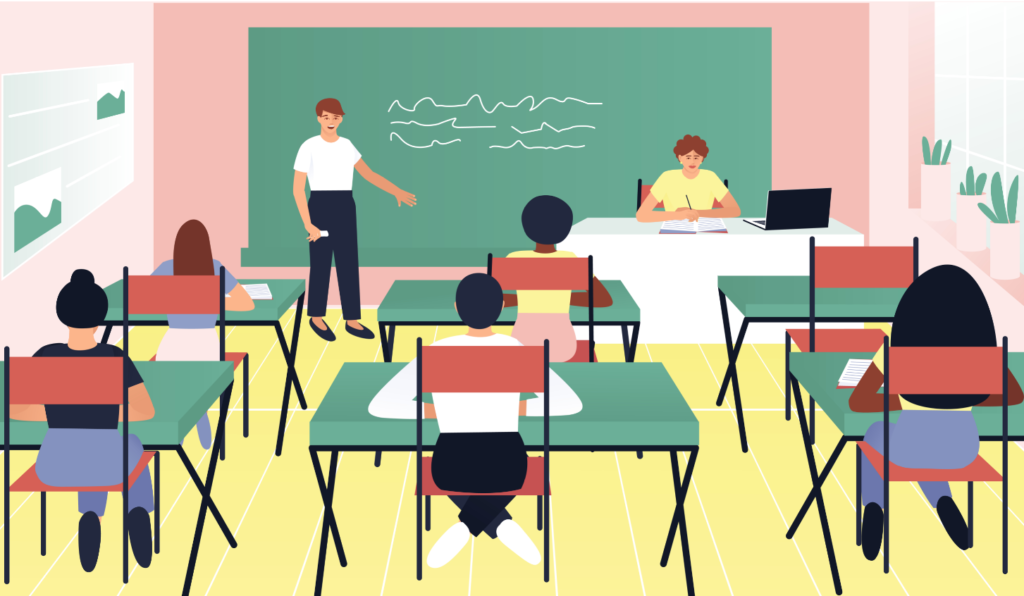
However, traditional classrooms may have limitations in terms of accessing up-to-date and authentic language resources compared to technology-enhanced classrooms. Traditional classrooms, in which teachers stand in front of learners, give lectures, explanations, and instructions by using blackboard or whiteboard (Ahmadi, 2018). In this method, learners do not have much motivation other than using technology (Furió et al., 2015). However, the learners need some guidance from teachers concerning appropriate sites and how to apply them (Amutan et al., 2020). Meanwhile, both the technology-enhanced and the traditional classroom lesson improved the children's knowledge in similar ways.
In a real situation, both digital learning or technology-enhanced classrooms and traditional classrooms can have collaboration in the learning and teaching process. Technology, like mobile digital devices, is a great option for teachers to find a new way to teach a lesson, especially English, which are the most useful innovations in the classroom (Akyuz & Yavuz, 2015). Even though it is required to train the teachers and give supplementary instruction to the learners about the technological material. Teachers can have access to many up-to-date resources if they can learn how to use technology. Exploring many resources will improve learners' knowledge in english. Akyuz and Yavuz (2015) said that using new technologies can have a meaningful effect on learning. Sariyatun et al. (2021) also said digital learning should be implemented in a blended learning to improve learners’ social skills. Digital learning materials demonstrate their ability to connect learners and foster social interaction and communication in cyberspace by improving social skills (Sariyatun et al., 2021).
In short, learning with digital learning using mobile devices or traditional classrooms with teachers can have its own challenges. Digital learning may have a lot of access to resources, flexibility in time or place (learn anywhere and anytime) (Caudill, 2007), various forms of material (Hadijah, 2016), etc. On the other hand, learners can be addicted to technology (GÖK, 2015) and affection to identity or social attitudes (Sariyatun et al., 2021). Meanwhile, traditional classrooms have improvement in social skills (Sariyatun et al., 2021), guidance (Amutan et al., 2020), etc. Although a traditional classroom may not have a lot of access to many resources and learners' less motivation (Furió et al., 2015). However, in the learning and teaching process, digital learning or technology-enhanced classrooms and traditional classrooms can have collaboration. Teachers can use technology, like mobile digital devices, to find new ways to teach a lesson, especially English, which is one of the most useful classroom innovations (Akyuz & Yavuz, 2015).
References
- Ahmadi, M. R. (2018). The Use of Technology in English Language Learning: A Literature Review. IJREE, 3.
- Akyuz, S., & Yavuz, F. (2015). Digital Learning in EFL Classrooms. Procedia - Social and Behavioral Sciences.
- Amutan, K. I., Ching, H. S., Ramalingan, S. J., Maruthai, E., Kandasamy, P., Mello, G. D., Munian, S., & Ling, W. W. (2020). Challenges of Learning English in 21st Century: Online vs. Traditional During Covid-19. ResearchGate.
- Anas, I. (2019). Educational Technology and Teacher-Student Technology Competency: a Pathway to Teaching English with Technology. ResearchGate.
- Arifah. (2014). Study on the use of Technology in ELT classroom: Teachers’ Perspective. BRAC University. http://hdl.handle.net/10361/3999
- Caplan, S. E. (2003). Preference for online social interaction: a theory of problematic internet use and psychosocial well-being. Communication Research, 30(6), 625-648. https://doi.org/10.1177/0093650203257842
- Caplan, S. E. (2005). A social skill account of problematic internet use. Journal of Communication, 55(4), 721-736. https://doi.org/10.1093/joc/55.4.721
- Caudill, J. G. (2007). The Growth of m-Learning and the Growth of Mobile Computing: Parallel developments. 8. 10.19173/irrodl.v8i2.348
- Furió, D., Juan, M., Juan, I., & Vivó, R. (2015). Mobile learning vs. traditional classroom lessons: A comparative study. Journal of Computer Assisted Learning, 31(3), 189-201. 10.1111/jcal.12071
- GÖK, T. (2015). THE POSITIVE AND NEGATIVE EFFECTS OF DIGITAL TECHNOLOGIES ON STUDENTS' LEARNING. The Eurasia Proceedings of Educational and Social Sciences. http://www.epess.net/en/download/article-file/332850
- Hadijah, S. (2016). TEACHING BY USING VIDEO: WAYS TO MAKE IT MORE MEANINGFUL IN EFL CLASSROOMS. 4. https://ejournal.unp.ac.id/index.php/selt/article/view/6990
- Kirkwood, A., & Price, L. (2014). Technology-enhanced learning and teaching in higher education: what is ‘enhanced’ and how do we know? A critical literature review. Learning, Media and Technology, 39, 6-36. https://doi.org/10.1080/17439884.2013.770404
- Sariyatun, Suryani, N., Sutimin, L. A., Abidin, N. F., & Akmal, A. (2021). The Effect of Digital Learning Material on Students’ Social Skills in Social Studies Learning. International Journal of Instruction, 14(3), 417-432. https://doi.org/10.29333/iji.2021.14324a
- Shadiev, R., & Yang, M. (2020). Review of Studies on Technology-Enhanced Language Learning and Teaching. 12(2). https://doi.org/10.3390/su12020524

0 Comments:
Posting Komentar